An Invisible 'Archive'
I have been fascinated by videography for as long as I can
remember (🎬J.Meijer B.V. Jubileum). I was also lucky to grow up with parents who recorded
almost everything, leaving our family with an unusually rich
archive of ordinary days, holidays, birthdays and small moments
that would otherwise have disappeared.
The footage was technically preserved, but it did not feel
accessible. Much of it lived inside random OneDrive folders, old DVD exports
and VIDEO_TS directories. Finding something meant knowing that it
existed, remembering where it was stored and then opening it on a
desktop computer that had the latest version of VLC player installed. The archive was safe, but psychologically almost
invisible (and incredibly frustrating to access).
The ChallengePreserved is not the same as present.
Folders protected the files, but made casual rediscovery and
family living-room viewing unlikely.
The OpportunityGive memories an inviting front door.
Familiar streaming patterns can make dates, people, places and
collections feel immediately browsable.
The Idea
We are an Apple family (copping to it) and I kept thinking
about how different the material would feel if it were available
in the living room with the same sense of occasion as a film or
series. That became LELIBRAMBAS+: a private streaming experience
for our own home videos, presented under the deliberately
over-serious, satirical banner of LeliBrambas Studios™.
The goal was not to pretend our home videos were blockbusters. It
was to make them easy enough to watch that they could become part
of family life again.
Why television
The television is a shared, low-friction place. A ten-foot
interface lets someone choose a memory from the sofa, then watch
together without navigating folder trees or moving a laptop
around. The prototype targets Apple TV and Android TV through Expo
and React Native TV. Its high-fidelity browser implementation
supports rapid Windows validation; the smaller native entry
validates the TV stack and focus primitives, but does not yet
mirror every browser discovery surface.
SharedDesigned for a room
Large type, strong contrast and restrained density support
viewing from a distance.
FamiliarStreaming conventions
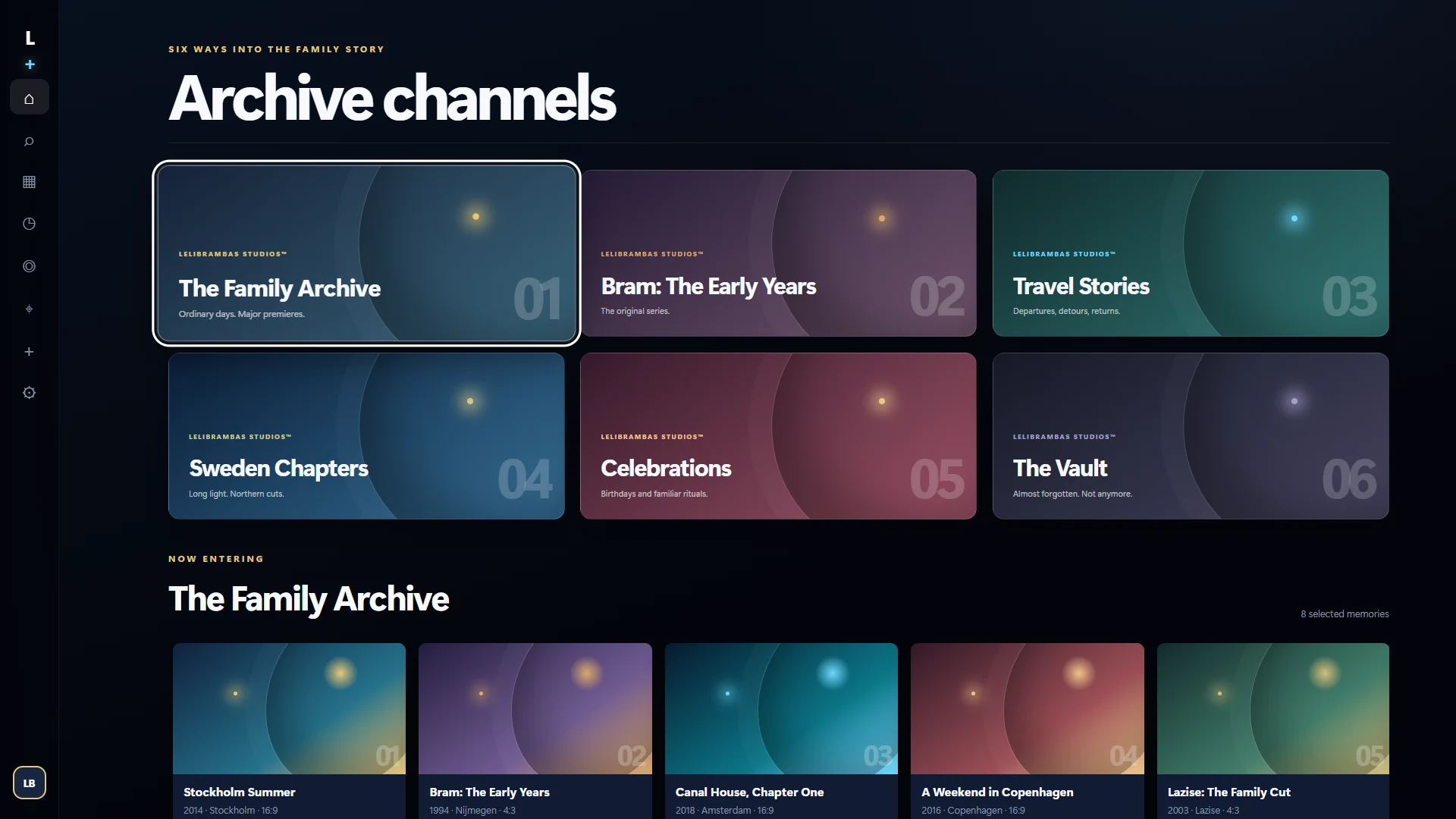
Heroes, rails, details and Continue Watching reduce the
learning curve.
RespectfulArchive first
Original aspect ratios, approximate dates and restoration
notes remain visible.
The
viewing experience
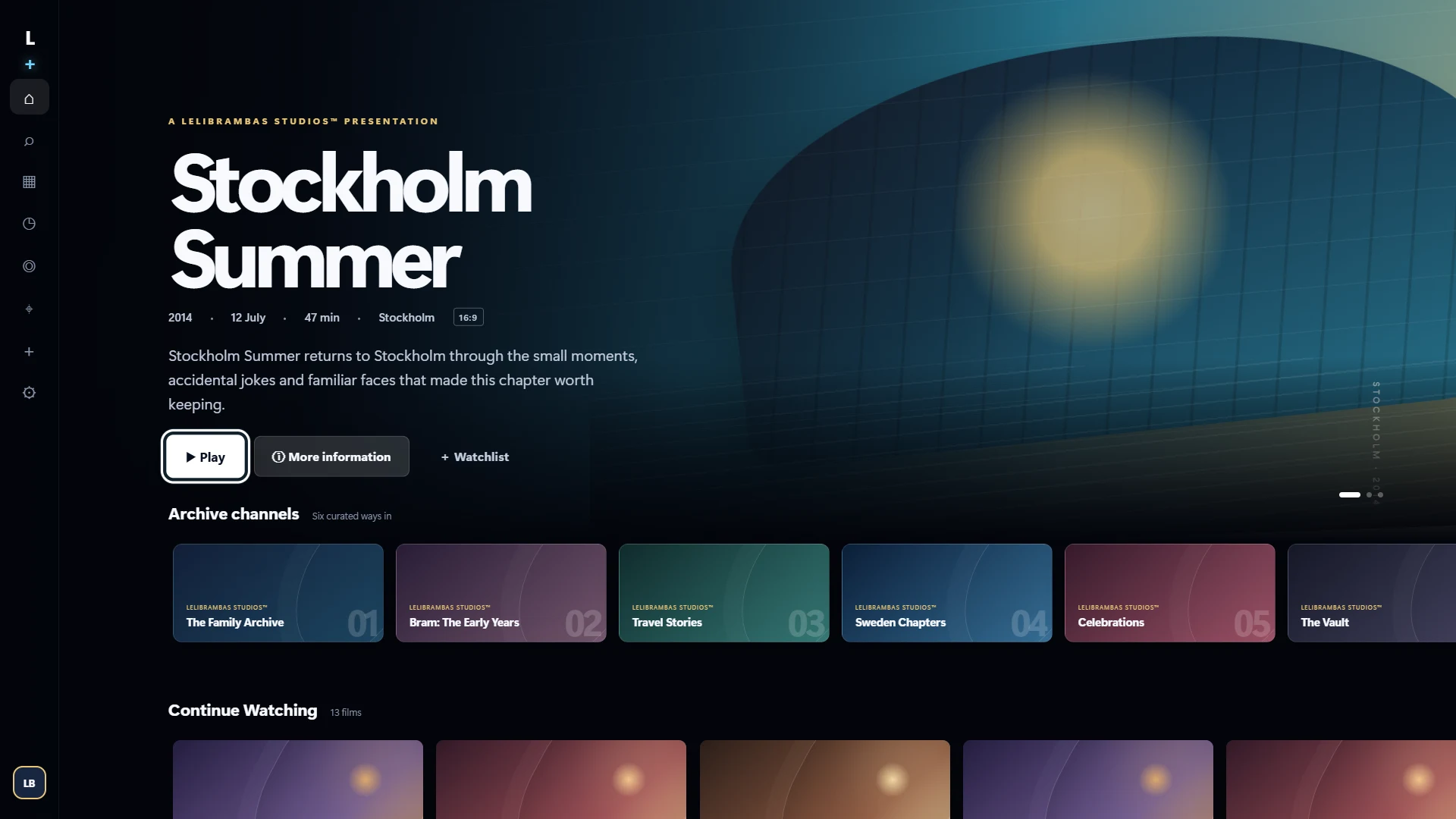
The viewer opens with a short LELIBRAMBAS+ splash, moves
to profiles, then presents one featured memory and curated rails.
Details explain when and where footage was recorded, who appears
in it and whether a date is approximate. Progress belongs to a
profile, so leaving halfway creates a meaningful Continue Watching
row and Resume action.
Designing for a Remote
A television app cannot depend on hover, a cursor or tiny touch
targets. Every actionable element participates in deterministic
spatial navigation. Arrow keys or a directional pad choose the
nearest candidate in the requested direction; Enter activates it;
Back restores the prior screen and focus context.
FocusImpossible to miss
A white outline, offset halo, small scale change and elevation
communicate both position and depth.
MotionFast and optional
Focus transitions stay around 180 ms and respect
reduced-motion preferences.
Organising Memories
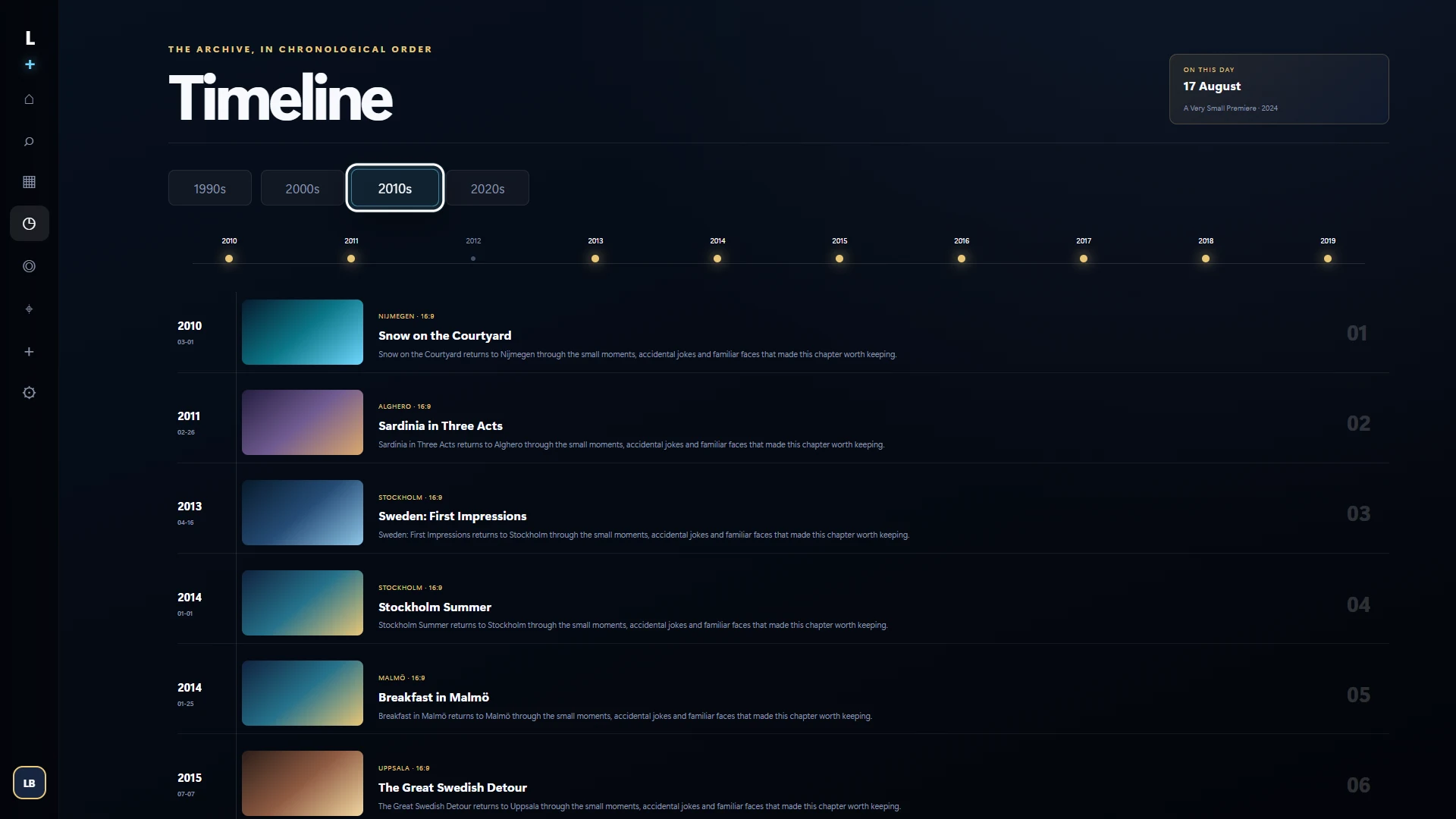
Folders are useful for storage; people remember stories. The
catalogue therefore supports search, collections and episodes,
decades, people, places, dates, themes and a private watchlist.
Missing artwork receives an intentional generated gradient instead
of a broken placeholder. Unavailable conversions stay
understandable without hiding the catalogue record.
Restoring old VIDEO_TS footage
Old DVD structures are treated as source material, not disposable
clutter. The implemented importer is designed to scan without
changing the archive, identify title-set candidates, suggest a
safe main title and create a resumable viewing-copy job. Its tests
cover detection, planning and recovery. HandBrakeCLI can improve
title discovery when installed, while FFmpeg is required to
produce the H.264/AAC MP4 derivative; neither executable was
available for a real family-source conversion on this Windows
ARM64 host.
ScanRead regular videos and VIDEO_TS structures without writing
to the source.
ReviewCompare candidate duration, cells and size before selecting a
title.
ConvertWrite a temporary derivative in a separate output
directory.
ValidateProbe the copy, checksum it, then atomically publish the
viewing file and manifest.
From OneDrive to the Living Room
The CloudFlare 2FA importer is designed to leave OneDrive as the preservation
layer, upload videos to a Streaming-database and grant access based on email-accounts and Apple 2FA. Accepted video-files are numerous (.mov for Apple, .mkv for older digital video recorders, .VOB for DVD encoding and traditional .mp4 for generic platforms).
Its tested placeholder-file path produces a clear error
instead of a damaged or partial copy. Relative source references
stay in ignored local state. The viewer reads generated demo media
today and can later switch to short-lived private streaming URLs
through the same provider interface.
Technical Architecture
The system keeps preservation, management and viewing
responsibilities separate. Shared schemas and provider interfaces
let the prototype run entirely locally while keeping a
production-shaped path to private cloud delivery.
Archive sourcesSynchronised files and read-only VIDEO_TS folders
Importer + catalogueResumable derivatives, validation and metadata review
Private viewersExpo TV, web and a sandboxed Electron shell
- Expo SDK 57
- React Native TV
- React + Vite
- Electron
- TypeScript
- FFmpeg
- Cloudflare Workers
- D1 · R2 · Stream
- Vitest
- Playwright
Admin | One Upload > Available Everywhere
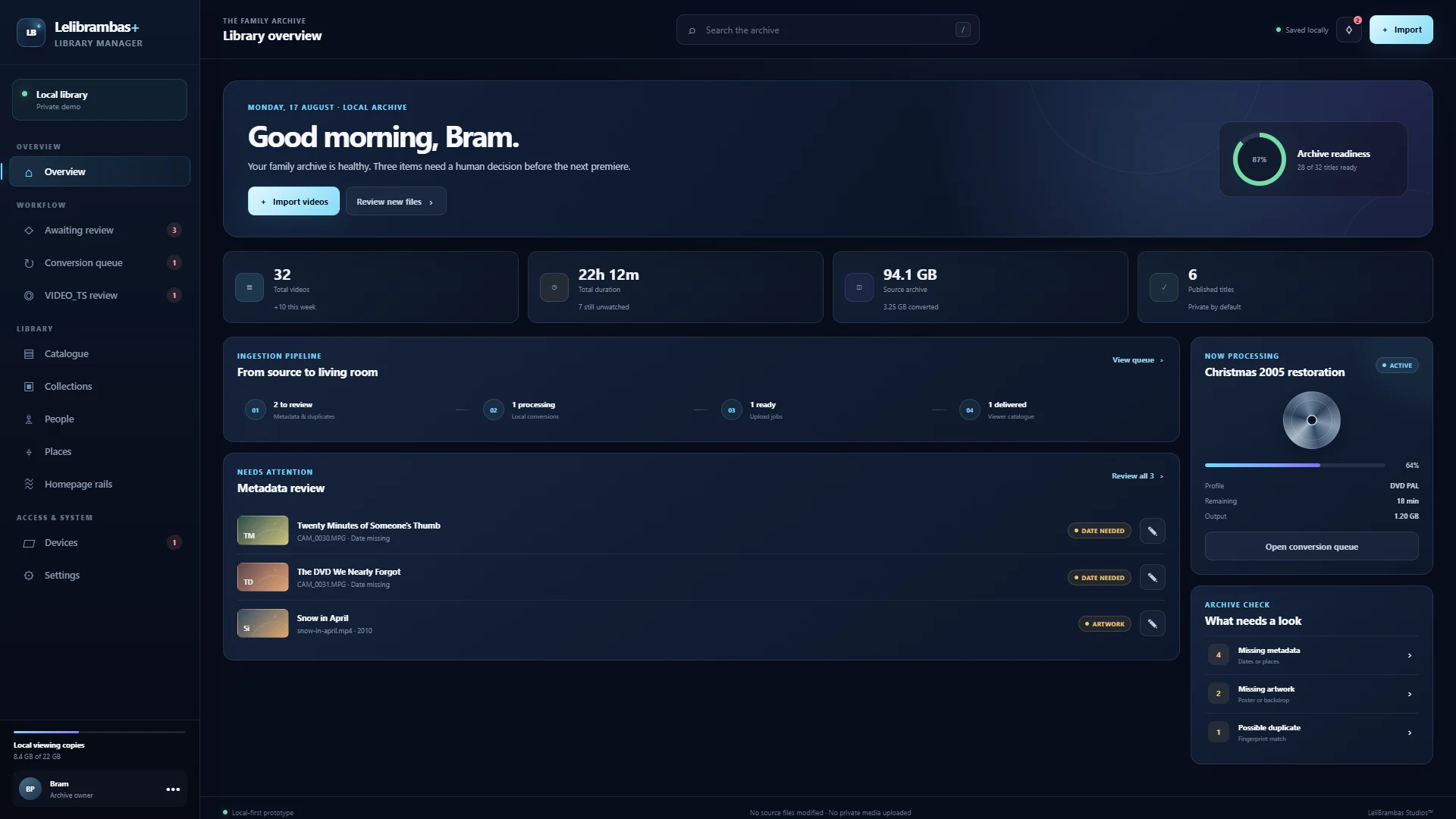
The family archive is managed through a dedicated upload portal, accessible only to the family administrator. From there, new videos can be securely uploaded directly to the cloud infrastructure behind LELIBRAMBAS+.
The portal connects directly with the Cloudflare API, allowing uploaded content to move from the administrator’s workspace into the archive without requiring manual file management or separate publishing steps. Once a video is uploaded and added to the catalogue, it becomes immediately available within the LELIBRAMBAS+ experience.
This creates a simple pipeline: upload once, and the memory becomes part of the archive everywhere.
Whether a family member is watching through the web experience, a mobile browser with app installation, or the tvOS app, the same central archive serves the content. The result is a streaming platform that feels less like a collection of stored family videos and more like a private, continuously evolving version of a modern streaming service.
Screenshot
gallery
Each image opens the original WebP capture.
Project Status
A fully functioning family archive is now live, with the web viewer, Library Manager, secure upload workflow, playback, progress tracking, discovery and production-shaped API all implemented. The family archive is fully populated with my own family’s content, and the native tvOS Apple TV app has been deployed to TestFlight, making the archive accessible as a true streaming experience across platforms.
This is the foundation for a much larger ambition: to evolve LELIBRAMBAS+ from a personal family archive into a customizable private streaming platform that anyone can own. In the long term, I want to make the product available through the App Store, allowing families to create their own branded, private streaming archive, upload and organize their memories, and experience them across Apple TV, mobile and web—essentially their own personal Netflix for family memories.
For me, success is not a bigger catalogue or a more theatrical
interface. It is the possibility that an ordinary afternoon
recorded years ago becomes easy enough to rediscover together,
without asking the archive to stop being private, imperfect or
genuinely ours.